Thursday, August 29, 2019

Regular Whopper vs. the Impossible Whopper (Food Kingdom Edition)


Burger v. Burger (If we Still Even Care About Burgers)
All the excitement over Popeye's Chick Fil-A-destroying fried chicken sandwich has somewhat eclipsed what had once been breathless hype over the Impossible Whopper.  With filet supplies exhausted at Popeye's nationwide for at least two weeks, this seemed to be a good time, now that the broiler smoke has cleared, to revisit the Impossible Whopper and see how it stacks up against one made with, presumably (an important presumption as DQ will tell you), real beef.

On the left, the Impossible Burger, on the right the Original Whopper.  Though this photo somewhat obscures the fact, they are both piled high with copious pickles, onions, lettuce, and tomato slices, and also slathered with ketchup, mustard, and mayo.  This served to obscure the differences between the two patties substantially, but not completely.


Live from Food Kingdom HQ, it's a Video Taste Test!


Conclusions
The Impossible Burger features what is, at this point, the best patty in the business, but the sandwich itself lacks the courage of its convictions.  Consumers want to taste this amazing new protein, not strain to discern its flavor profile because it's covered up with mounds of fixings and condiments.  Heme, the compound that tastes somewhat like real beef juices, is hard to detect here because of all the ketchup and mustard interference.  The fact that the flame broiling process burns off a lot of the heme liquids while imparting little smoke doesn't help either.  But if you're not paying attention, the Impossible Whopper tastes like, well... a Whopper, and that is worth celebrating.

Thursday, May 2, 2019

McDonald's Chicken Biscuit: Yes, It's Bigger, But Is It Better?

Back in the Biscuit Game
It's easy to understand why McDonald's would want a chicken biscuit offering at breakfast time and beyond.  Despite sitting atop the fast food world with $36 billion in U.S. sales, more than double the sales of its closest chain competitor (Starbucks at $14 billion) and four times the sales of its closest category competitor (Wendy's at $9.5 billion) the arches are wobbly on a per-unit sales basis, compared to Chick-fil-A, which boasts a whopping $4.4 million dollars in sales per location, nearly double McDonald's $2.5 million.

Followers will always try to follow leaders and steal their thunder in some way.  This isn't even McDonald's first attempt to do so.  About five years ago they introduced their "Southern Chicken Sandwich", a blatant note-for-note ripoff of Chick-fil-A's signature sandwich, sporting a buttered steamed bun, pickles, and a steamy pressure-cooked filet.  They also offered a breakfast chicken biscuit that clearly imitated Chick-fil-A's breakfast offering.  Honestly, both were pretty good imitations of the original, but consumers just didn't respond and the items were discontinued.  Maybe McDonald's should have offered waffle fries too.

Going Big and Going Different
Despite this lack of initial success, the pull of added profit was strong and, perhaps because of the success of all-day breakfast and the resulting all-day availability of biscuits, McDonald's has decided to give it another go.  They've introduced a new chicken biscuit, initially alongside a lunch sandwich that shared the same fried chicken filet.  That new lunch sandwich, dubbed the "Classic Chicken Sandwich" was again a simple affair: a soft bun, a chicken filet, a little special sauce, and pickles.  Frankly, I loved it, and it was a bargain at only $3, but it has since been discontinued.  I'm not sure why, though I suspect that it may have been too good a deal, cannibalizing sales of the deluxe line of sandwiches.  But we shall not dwell on this sad happenstance, as there's nothing to be done about it.

The first thing you notice about the new breakfast biscuit, officially and ostentatiously named the Buttermilk Crispy Chicken Biscuit, is how huge the chicken filet is.  I mean, it's obnoxiously huge, suspiciously huge.  When I first saw it, I thought it must be a bunch of crust with some fake pressed chicken loaf inside, because the value proposition suggested by a real chicken filet of that magnitude seemed impossible.  The sandwich offers the tantalizing prospect of up to six bites of pure fried chicken in the morning before your teeth even make contact with the starchy biscuit.  Could this be too good to be true?

An early, evocatively lit encounter with McDonald's Buttermilk Crispy Chicken Biscuit.  Note how the filet extends way beyond the borders of biscuit, offering unadulterated crispy chicken delight.

Tasting and Testing for Real Chicken, and Going Head-to-Head
Initial tastings of the chicken biscuit left me more than satisfied, and the product tasted like real chicken, but I had to know for sure, so on a recent early morning, I passed through both McDonald's and Chick-fil-A's drive-thrus to collect specimens for careful analysis back at the Food Kingdom labs.  The results, in retrospect, make a great deal of sense.  McDonald's chicken biscuit, consistent with its appearance, does give you a bigger, heavier sandwich than does Chick-fil-A's, but then it's also a bit pricier, $3.18 with tax vs $2.75 with tax for its competitor.  Let's let the pictures tell much of the story now.
At the official weigh-in, we see McDonald's biscuit clock in at a hefty 6.2 ounces.

Chick-fil-A's biscuit, while less expensive, also provides significantly less to eat, weighing only 5.6 ounces, a full .6 ounces less.  Blasphemous, but true!

Ah, but perhaps you're thinking that the McDonald's offering gets its great weight from a heavier biscuit. But you would be wrong!  The chicken filet is a full .81 oz heavier than the original competitor!  Note that, true to its name, the coating on the McDonald's filet is crispy, full of irregular crunchy edges

The Chick-fil-A filet is, by contrast, steamy and moist, rather than crispy and, all things considered seems to be somewhat paltry poultry.
So we've established that Mickey-D's biscuit sandwich is larger and weightier, but underneath the chicken's crispy coating, do we have real chicken, or is it rather a patty, a glorified oversized chicken nugget, a McChicken in a biscuit?  Let's look inside and find out.
When we tear away the crunchy coating, we see a real breast filet, not chopped and formed chicken forcemeat.  Yes, it's pounded a bit thin, but your three bucks is buying you the real deal.  Incidentally, though it's largely hidden on the menu, McDonald's does offer an even cheaper chicken biscuit that really is the proverbial "McChicken on a biscuit".  It's not bad for what it is!
Ultimately, a Difference in Style
We've heaped a lot of abuse, at least, implicitly, on Chick-fil-A, noting how much smaller it is than McDonald's bold, swaggery, crispy-crunchy-juicy chicken breakfast sandwich.  Ultimately, though, I wouldn't say one is better than the other.  As noted, the smaller sandwich is also over 40 cents cheaper and might be all you really need for a tasty, reasonably satisfying breakfast.  Let's review the differences in taste to help you decide what's right for you.

Crispy, Savory, but a Little Dry
On the plus side, McDonald's chicken biscuit is nicely spiced– peppery with hints of oregano and other subtle notes that delight one's sense of scent, and subsequently one's palate.  Its crunchy coating is something you can really sink your teeth into.  It truly is fun to just eat fried chicken with your coffee before you even get to the biscuit part.  The biscuit too is quite respectable and the savory flavor profile interacts nicely with coffee.  However, because the chicken is pounded thin in order to be wider, you don't get as much tender chicken flesh to sink your teeth into as you do with Chick-fil-A.


On the Sweet Side
Often, flavor traits are only detectable in contrast to something else.  I've had Chick-fil-A's chicken biscuit dozens of times, but until I had one right after I'd eaten at McDonald's, I'd never noticed how sweet it was.  I'm talking cake-sweet, both the biscuit and to a slightly lesser extent the coating on the chicken.  It's not a bad thing, but it provides a strong contrast to the other product.  Once you notice the difference, you might find it offputting.  On the other hand, this sandwich does so many other things right. Unlike its competitor, this biscuit is lightly stained by dabs of melted butter, and the chicken is cooked more carefully so that it's still steamy and moist on the inside.  This is real Southern comfort food and McDonald's still can't quite match the mood that it conjures.  The Chick-fil-A biscuit is cozy; the McDonald's one is jazzy, energetic, ambitious and sassy.  I recommend enjoying both, depending upon your mood.

Like Our Facebook Page So You Never Miss A Post!


Monday, March 25, 2019

The Secret Identity of McDonald's Donut Sticks

Off to a Bad Start
Your first experience with McDonald's Donut Sticks will be a feeling of getting cheated.  To be precise, you'll think they forgot to fill your order, instead handing you an empty bag.  Should you resist the urge to complain to the cashier and peek inside the bag, you'll see that the donut sticks are indeed there, but you'll still feel ripped off.  They're so light, so insubstantial.  How can they possibly provide value?
 
If McDonald's wants to convince the public that they're offering value for the dollar, they should serve these in a bag small enough for six donut sticks to fill.  Nobody likes to be handed a two-thirds empty bag.

Tasting Is Equivocating
Once you take a bite of your first donut stick, your mood will start to change, almost as if impelled by nature; you can't bite down on fluffy, salty, starch, fried in fat, and coated in sugar and cinnamon without an autonomic pleasure response.  Still, your neocortex might still assert itself and ask "but are these really donuts?"  If your Platonic conception of donuts begins with the template of the basic cake donut, hefty, sodden, and sweet fried batter that sits like a satisfying glutenous lump in your stomach and easily serves as a proxy for a filling breakfast, then the answer is surely no, these are not real donuts.  If, on the other hand, your idea of a donut is more like the classic Krispy Kreme donut -- a light, insubstantial sweet nothing that dissolves in your mouth and vanishes, like the last five minutes of dreaming before the alarm wakes you -- then these donut sticks dwell in the general vicinity of the donut.
There's a lot of air in there! No shame in that.  Puff pastry, croissants, and pate-aux-choux all operate on similar principles, but the consumer should not chew a donut stick unprepared, lest they think it somehow missed their mouths.


The Veil of Mystery Is Lifted
And yet...something still seems off.  You've tasted something like this before, but it wasn't called a donut, it was something else.  These sticks are so light and airy, with gigantic voids, bubbles, and pockets rendering them nearly hollow, a tender, sugar-dusted, chewy shell encasing sweet warm vapor.  They collapse with each bite, deflating to something scarcely thicker than a tortilla.  What do these remind us of?  Churros?  In flavor, certainly, but they seem more like dinner rolls or buns than churros, which again are not far from cake donuts, do.  And then it hits you: these are sticks of fry-bread, that Navajo invention created out of necessity from government flour, sugar, salt, and lard that's since become a staple of state fairs as much as of Native American culture.  Puffed up, bready, lighly coated in oil and enlivened with sugar and sometimes other spices.  Once you accept that this is what McDonald's has decided to serve you, labels be damned, all your quibbles will disappear and you can enjoy them like the magically addictive treats that they are.
Enlarged to show texture and you can clearly see that a more accurate description of the product would be "fry-bread sticks."

Eating Strategies
McDonald's Donut Sticks come in two order sizes, the 6-piece and the 12-piece.  Because they're so light, it's quite easy to consume 12, but because they're so rich you may regret it afterwards; you'll start to feel sick before you start to feel full.  I recommend starting with six and seeing if you can be content with that.  They even offer a combo of six sticks and a small coffee for $3 and change, a prudent nudge I would say.


The other thing every eater must decide for themselves is what to do with the leftover cinnamon sugar that remains in the bottom of the bag or, if you dump them out onto your tray, then on your paper tray cover or napkin.  You can try to incorporate some of it back into the donut stick itself by dipping the exposed bitten end into the layer of sugar after each bite uncovers a new bit of donut cross-section, but that is unlikely to use it all up.  At that point, you're either the kind of person who will lick your fingertip, dip that moist fingertip it into the sugar to retrieve some of it, and then lick your finger again...or you're not.  It is very unlikely that any of us have the fortitude to consume all the excess cinnamon sugar.  That's ok.  It's alright to sometimes leave something on the table, as it were.

The messy aftermath of a session with 12 (sorry, not sorry) donut sticks. There is no way to quickly consume all this grease-inflected cinnamon sugar and I advise against attempting to devise one.

A Starbucks Killer?
It puzzles the more rational among us that Starbucks created a multi-billion-dollar empire off pedestrian coffee with syrup and whipped cream.  How a tablespoon of syrup and a 1/2 cup of whipped cream adds $3 of value I'll never understand, and it was entirely understandable that McDonald's thought they could undercut Starbucks, offering an identical product for about 35% less cost.  But consumers tend to behave as sentimentally as rationally and McDonald's will never recreate the upscale oasis ambience that engenders such customer loyalty to the Seattle chain.  That said, McDonald's has created at least one warm, sweet reason to at least occasionally park under the Golden Arches for your morning caffeine fix.

Thursday, June 14, 2018

Maltesers Are Not Whoppers: A Tale of a Non-Redundant Candy

The Mystery Candy Once Exclusive to Movie Theaters
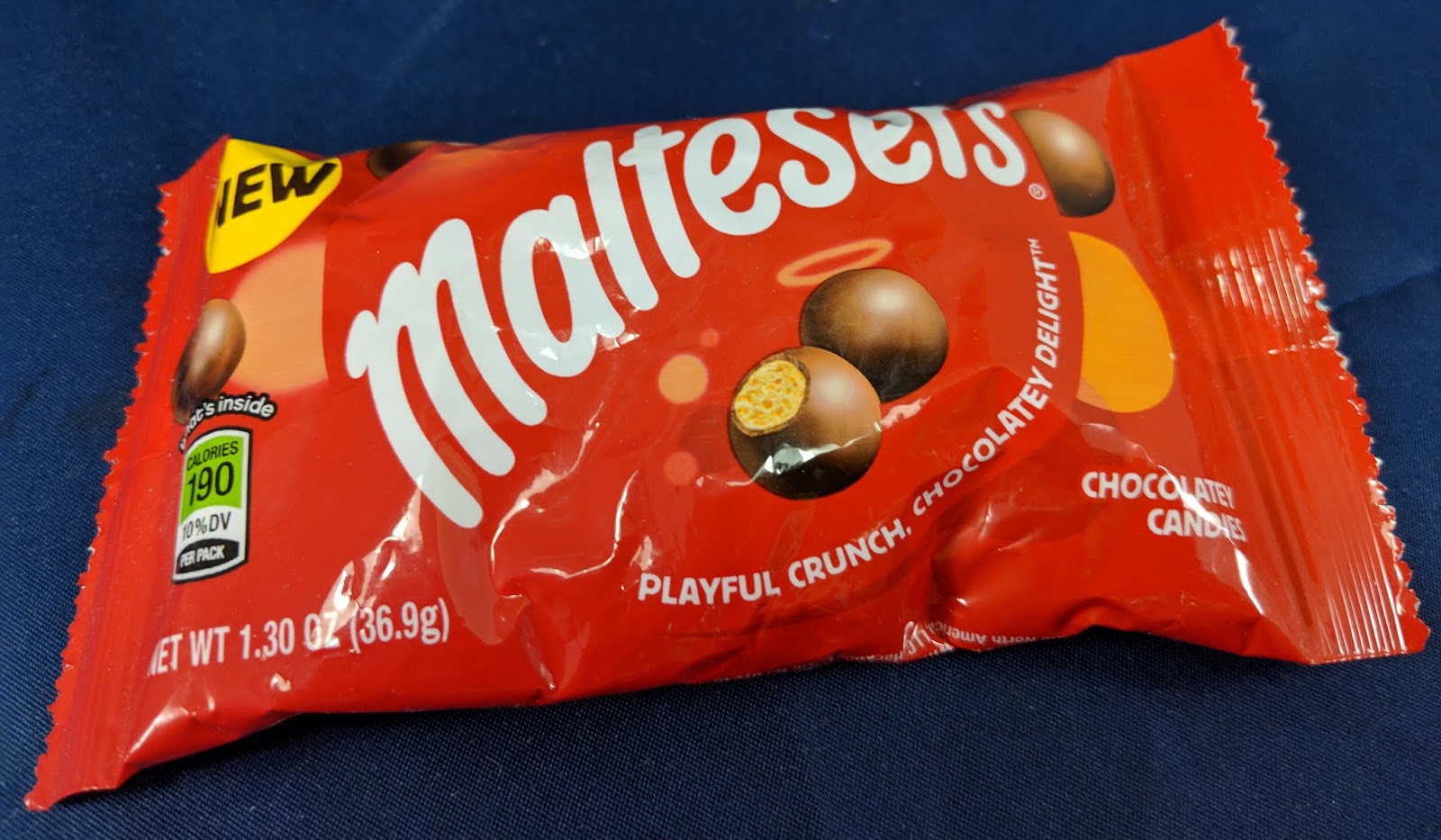
Beginning in January of 2017, you may have seen an unfamiliar yet recognizably typical candy pop up in your local multiplex; something called Maltesers that, by all appearances were just a rip-off of Whoppers malted milk balls.  Trumpeted as available exclusively in theaters, you may have wondered where the privilege lay in overpaying for a ripped-off version of a beloved but decidedly unexciting and stodgy candy with no particular present-day cachet.  Initial appearances to the contrary, however, Maltesers have an interestingly different taste, and a fascinating back-story, that make them worth your time.  First then, a little history.

Available for the first time in the United States after more than 70 years as a European candy, Maltesers appear at first glance to simply be a Euro-version of Whoppers malted milk balls.  But look closely, dear reader, and see if you can spot a difference.  Now read on, to see if you're right.

A Prodigal Confection Returns Home
Maltesers are both American and non-American, European and domestic.   Wikipedia classifies them as a "British confectionary product" because they were created there in 1936 and have been primarily a European product ever since.   But their creator was an American, Forrest Mars of the Mars candy fortune, living abroad during a period of estrangement from his father.  While in Europe, he worked for Nestlé and Tobler, acquired a British dog food company, and then finally returned to the States where he would create M&M's (inspired by a now-forgotten Spanish candy) while at the head of his own food company, before finally reuniting with Mars, Inc. after the death of his father.  Despite this corporate reunion, Maltesers never accompanied Forrest back across the Atlantic, remaining exclusively a product of Mars Europe until 2017.

What We've Been Missing All These Years
All this history is mere trivia, though, if Maltesers don't have anything special going for them.  They are indeed malted milk balls, just like Whoppers.  But there's an important difference in terms of texture: Maltesers are much lighter.

It's easiest to understand the difference by analogizing to rocks.  Whoppers are like sandstone, fine-grained but densely packed together without much air separating the sandy granules of malted milk.  They offer crunchy resistance to the bite, fracturing, shearing, and then gradually breaking down into smaller chunks and ultimately their constituent grains.  Their relatively thin coating of chocolate wears away and dissolves long before the malted milk center does and so the last thing you taste before the candy dissolves is a pleasingly malty paste, inflected with a touch of cocoa.

Maltesers are more like basalt or pumice, with large voids, giving them an airy lattice-like structure that yields to the bite, weakens quickly, and dissolves soon thereafter, furtively tucking its own remnants into the relatively thick chocolate coating, nestling there in trace amounts as the chocolate slowly dissolves, inflected sweetly and gently by malty notes.  The experience isn't unlike eating cotton candy in that the volume of the sweet impresses and yet disappears rapidly on contact with the tongue.

The nearly identical exteriors of Whoppers and Maltesers conceal great differences on the inside.  Whereas Whoppers are dense and chalky, Maltesers are light and airy.  Incidentally, our new malty friend is pronounced "Malt-teasers" as though they might hail from Malta.  All hail Maltesers!
Conclusions
To note a difference is not to express a preference, and there should be room in the American candy cupboard for both of these malted milk balls.  Whereas Whoppers are bold, snappy, sweet, and crunchy with an aggressive maltiness, Maltesers are winsome, crispy, creamy, and yielding.  I shall refrain from analogizing from their traits to any aspects of the respective American and European characters and simply direct you to your local corner store, where Maltesers are now more broadly available outside of movie venues, to judge for yourself.

Like this story? Like our FB page so you never miss a post!

Tuesday, March 27, 2018

Hershey's Gold: Peanuts and Pretzels From Heaven -- But Don't Call It Chocolate


Something New in the Chocolate Space

You may have noticed when perusing the candy aisles that Hershey's has released its first straight "chocolate" bar in quite some time.  Called Hershey's Gold, it promises a "caramelized creme" flavor and is loaded up with peanuts and pretzels.  Absolutely addictive, it's their best new product in over a decade.  

The wrapper is a mass of clichés: after all, the term "gold" has been abused and overused so much as to be devalued, peanuts and pretzels seem a bit played out, and who knows what "creme" means?  But there is nonetheless confectionary gold in that there bar. 

But Is It Really Chocolate?
Before turning to the sublime taste, let's veer off into the weeds for a second and consider whether it ought to be called a chocolate bar.  There are some for whom the very concept of white chocolate is heretical.  Technically they haven't a right to say so, since genuine white chocolate, a mix of cocoa butter, sugar, milk solids, and flavoring, does derive from the cocoa bean, missing only the dark brown nibs that contain chocolate liquor.  This "golden" chocolate can't even claim that much; it doesn't contain any cocoa butter, instead using a variety of different fats (palm, sunflower, shea, soybean, and safflower oils) in its place, though it does at least contain some emulsifying milk solids.  This was the formula briefly employed by Hershey for their classic Mr. Goodbar before rival Mars called them out for it, mockingly alleging with complete accuracy that Mr. Goodbar couldn't even be called chocolate but instead merely cocoa-flavored vegetable oil.  Today Mr. Goodbar contains some cocoa butter along with the other cheaper fats,  with Hershey reserving the 100% cocoa-butter formula primarily for their iconic flagship chocolate bar.
If the consistency seems a bit crumbly, ragged, and ratty, you might chalk that up to the lack of cocoa butter, which is uniquely creamy and anti-brittle.  Thankfully, this bar is all about butterscotch flavor.
Who Cares?  It's Devastatingly Delicious
This is all quite interesting to someone obsessed with these things like me, but if you're a prospective eater, you really just want to know how it tastes.  All I can say is that, unlike any other new candy that's come out recently, I just can't stop buying and devouring this one.  While the absence of cocoa butter makes it texturally thin (cocoa butter is extra viscous and creamy) this bar has the salty-sweet thing down in spades.  Taking a bite and waiting for it to melt, the little shards of pretzel and peanut present themselves to your taste buds, bidding you to crunch, at which point your mouth is awash in brown-sugary butterscotch flavor, little sparkles of salt crystal, and earthy peanut pretzel-bits that tie it all together with textural diversity.  It's a lot of pleasure for around a buck, so get out and buy one!
A view of the underside reveals a thin bar shot through with a rubble of peanut and pretzel fragments that offers a crunchy counterpart to the creamy/salty/tangy caramelized body of the bar.

Wednesday, October 18, 2017

Mystery Oreos: The Taste of Pure Imagination

Preposterous Ploy or a Pleasing Puzzlement?
A cynic would explain the appearance of Mystery Oreos this way: the flummoxed flavor wizards at Oreo, suffering a food chemist's version of writer's block, failed to think of any new ideas for novelty flavors and, in a fit of desperation, settled on some undefinable but pleasant-tasting combination of extracts that they would offer consumers, saying "you tell US what it is!"  It's certainly a viable conspiracy theory but, as with many such fever-dreams, it is not supported by the evidence.  Here at the Food Kingdom, all available staff (and other volunteers) have tasted these mystery cookies and they taste quite definitely of something.  We just can't agree what that something is.
Oreos has revved up the excitement by offering a grand prize of $50,000 for one person who correctly guesses the mystery flavor, and 5 $10,000 runner-up prizes.  But don't get too excited.  There will likely be thousands of entrants who guess correctly, and the winners from that pool are selected by random drawing. This is more of a sweepstakes than a contest.  Unless the correct answer is Blueberry-Banana Ecto-Cooler Crunch or something.
Blind Tasting
Mystery Oreos can't be evaluated by the same method that we've used to assess previous limited-edition flavors.  Usually, one of the judging criteria is the fidelity of the cookie to the treat that it's attempting to resemble.  With a mystery flavor, we don't even know the target, so it's impossible to say, in advance, whether it hits the mark.  Instead, we can simplify our questions to two: does it taste good, and does it seem to resemble something that exists in the world?  That search for that second answer is what has made this a rewarding tasting experience, as our minds and taste buds have trod together the alleyways of remembered pleasures, chance and contingent associations, and weird threads of synaptic connection between sensation and identification, aiming at knowing and barely missing, all the while caught in a sensual swirl of cookie and cream.
They don't look like much.  Except for a slightly lighter shade in the wafers, and a thicker helping of creme, Mystery Oreos look just like regular Oreos.  But just as reading a novel is often more vivid than watching the film adaptation, removing visual clues from the equation equips the mind of the taster to conjure wonders that colors and identifying labels might well suppress.

Fruit Is Definitely Involved
While our Food Kingdom panel hotly disputed the specifics, all but one on the panel agreed that these were fruity.  Essential fruit oils infuse the slab of creme inside the cookie, and that portion of creme is extra thick, necessarily I think because, in the absence of coloration and the guidance of an official flavor designation, the flavor needs to be extra strong to be identifiable.  Having said that, the cookie itself, which is slightly lighter in color than that of a classic Oreo, also has a hint of fruit.  I'm going to go out on a limb and declare the flavor to be orange or orange creme.  That was the flavor that just popped into my head the moment I tasted it, and while other suggestions from the panel were provocative and intriguing, subtly influencing my perceptions on subsequent tastings, and allowing for the aforementioned adventures in dreamlike speculation, I still kept coming back to something citrusy and, specifically, orangey.  Cointreau.  Grand Marnier.  Orange Milano.  These were the phrases that kept recurring over and over to me.  So orange it is, my (and Jen G's) official guess.  But there are others.  Let's hear from the panel now.

Other Official Guesses

Peppermint (my Aunt Lynn): I really didn't expect this guess, but she was quite insistent and I had to admit that, when I put myself in the right frame of mind, I could see where she was coming from.
Pros: It needs no additional coloring for it to be correct, and it's counterintuitive.
Cons: Oreo has already come out with a green mint variety, so this wouldn't be particularly new.

Fruity Pebbles (Maureen F, James N, and Brian S): Mo says that was her gut reaction and she's sticking with it.  Brian, damning with faint praise, writes "It has that fruity cereal taste.  It's good but not something I want to eat more than one of in a sitting." James N was more expansive, emphasizing the nostalgia they evoked and concluding that "it had enough faux fruitiness to taste different.  Ultimately, I wouldn't buy [these] over the original flavor, but I may buy a box of Fruity Pebbles next time I'm at the store!"    
Pros: The multicolored creme filling would be awesome! Like rainbow sherbert!
Cons: It's sort of an "all of the above" answer.  Is that a cop out? Also, consider the licensing costs of getting the naming rights from Post cereals.

Froot Loops (Trisa B and Inés P)
Pros: Again, one can certainly "taste where she's coming from."
Cons: What's with the breakfast cereal thing?

Bubble Gum (Kelly R)
"Bubble gum was the first thing I thought of.  Either that or Froot Loops"
Pros: Major points for originality and, when you consider how artificial the whole thing is, it makes perfect sense.
Cons: Ewwwwww....really?

Lemon Creme (R. de Moraes)
"It reminds me of ladyfingers with a light lemon frosting"
Pros: Mr. de Moraes has a discerning palate that is picking up the definite citrus note
Cons: His full description is basically likening this cookie to a pre-existing citrus cookie, which Nabisco will not be happy to hear.

Audience Participation!
Now it's your turn.  Let's see how many interesting guesses we can gather together in one place.  Please send your official guesses (after you enter the contest please, I don't want to be accused of stealing your idea!) to foodnfreak@gmail.com with the subject line "Mystery Oreos."  I will compile the answers and share them in a later post so we can all learn together.  Please let me know how you'd like to be identified or whether you'd prefer to be anonymous.  Happy tasting!


Thursday, October 5, 2017

Apple Pie Oreos: In Praise of the Fake

Our Chemical Romance
Mark Twain quipped that "a 'classic' is a book that everybody praises but nobody has read" and so it is today with the cult of the all-natural.  We all claim to desire all-natural foods, but when General Mills replaced the artificial food dyes in Trix with the drab natural hues of strawberries, turmeric, and beet juice, customers revolted and the joyous artificial rainbow was restored.  Keeping a convenience food all-natural is relatively easy when all you're doing is producing a canned, dried, or frozen rendition of an actual dish; it's easy to put real cheese on a frozen pizza and real beef in Hormel chili.  What are canned peaches in essence but, well, canned peaches?  But if you want peach-flavored bubble gum or grape lollipops or kiwi-mango gummi bears, you've got to break out the chemicals.  Intuitively we understand this and the reasonable among us don't object when our pack of Starbursts discreetly allows that it contains "natural and artificial flavors."  Those mysterious flavor compounds that imbue taffy with the essence of banana are uncannily effective.
Honestly, which would you pick?  The technicolor tribute to industrial engineering that is Trix Original or the East German all-natural version?
Synthetics: As American as Apple Pie
Nabisco has been applying, and continues to apply, this lesson in their dozen-plus-per-annum excursions into new and novel flavors, and their proudly artificial Apple Pie Oreos are a vindication of that approach.  Would it have been technically possible to dry out real apples, puree them, and fold that puree into the creme filling that's sandwiched between two graham-flour wafers?  Indeed, it would have been, but the creamy texture would have been disrupted and the apple flavor would have been quite faint.  One problem with natural flavors is that they're not very concentrated.  A wedge of apple requires all of its substantial bulk to transmit a potent punch of apple flavor.  It's too busy being an apple to taste of an apple in a pungent way.  That's why a real apple pie has to be about 85% apple by weight in order to taste strongly of apples.  With Apple Pie Oreos, Nabisco needed a creme filling that constitutes about 33% of the cookies weight to supply a blast of apple that would suffuse the entire cookie, and for that they needed to break out a full battery of ersatz compounds.
The package art neatly demonstrates the challenge that Nabisco faced: compressing the taste of layer upon layer of apple slices into a thin sliver of sweetened shortening.  Science knows the chemical components that make up the apple flavor profile.  One bite of this punchy little cookie and you'll f***ing love science.
The Canny Choice to Emulate Pie
Oreos' choice of novelty flavors haven't always been the wisest.  Root Beer Float and Banana Split may have been the most egregious follies, for they both attempted to emulate items known for being cool and refreshing with a cookie that is, by it's nature, room temperature and crumbly.  Aiming to simulate pie is genius because of the tight relationship between the original and the copy.  Pie crust is made of flour and shortening.  Oreos are dry, sweetened flour wafers filled with sweetened flavored shortening.  The use of graham flour in the wafers also makes a lot of sense, for it makes the cookie looser, more crumbly and granular, so that when the sweet apple-flavored shortening mixes with the coarse graham crumble, it's like tasting the melted butter that bastes the layers of flaky pie crust.  With all these elements attended to, the only x-factor was how convincing the artificial baked apple flavor would be.  I'm happy to report that the rich apple creme tastes extremely realistic.  No, there are no juicy chunks of apple, but when you've been chewing on a real bite of apple pie, those chunks collapse into a undifferentiated mash within your mouth fairly quickly anyway.  These cookies don't taste like a bite of fresh apple pie -- they taste like a bite of fresh apple pie 10 seconds later.  A lovely image, I know, you're welcome.
Redolent of golden, oozing baked apple coated in caramel-like sauce, nestled in rich, buttery, brown-sugary crust, Apple Pie Oreos reminded me of another junk-food favorite: Taco Bell's Apple Empanada which, while delicious, also has hardly any real apple in it.  What's their excuse?

Conclusions, But No Consensus
My enthusiasm notwithstanding, these don't seem to be for everybody.  These cookies attracted much attention within the Food Kingdom offices, with Maureen F., James N., and Brian S. all having a go.  Maureen, hopefully by mere coincidence, is out of the office today, but James and Brian both keyed in on what they perceived to be excess sweetness.  Said Brian, "it does have a hint of apple taste but it's way too sweet for me.  It doesn't taste at all like an Oreo, which is not a good thing.  Agreed James, "[it] tasted a lot more like apple pie than I expected, but it was also overpoweringly sweet.  I'll stick with the classic Oreos" showing that for some, making a pie out of Oreos is more successful than making Oreos out of a pie.  Dear reader, you shall have to sort this out for yourself, which you may do for what is apparently a limited time.